Author: Editor1

  • Workers Shot, Reporter Killed in Fight for Increased Wages

    Workers Shot, Reporter Killed in Fight for Increased Wages

    Note:  A big thanks to those who lent their solidarity to the workers and peasants of Batay Ouvriye during RRN’s emergency Summer/Fall 2021 fundraiser! Thanks to you we surpassed our $10,000 goal. Your support played a role in helping these workers through a very difficult time, so that they could organize this current campaign for 1,500 gourdes.


    Thursday, February 24, 2022
    Port Au Prince, Haiti

    Since February 9th, Haitian garment workers have been striking and taking the streets of the capital Port Au Prince to demand an increased minimum wage of 1,500 gourdes per day ($14.41 USD) from 500 gourdes per day ($4.80 USD).

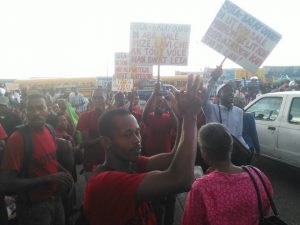
    Since the start of these mobilizations, workers and their broad base of supporters have been met with tear gas and police repression. But yesterday, February 23rd, the repression reached a new intensity with one reporter shot and killed, reports of two other people injured and sent to hospital, and a worker who took two bullets to the leg is also in hospital. Several people were grazed by bullets and tear gas canisters launched at workers and protestors.

    REUTERS/Ralph Tedy Erol
    REUTERS/Ralph Tedy Erol

    The strike action and march on Wednesday, February 23rd was a response to the government’s insulting offer of 685 gourdes per day ($6.50 USD). For perspective, one egg costs about 50 gourdes. One banana costs about 25 gourdes. A plate of spaghetti from a lunch vendor costs about 100 gourdes. Transportation to and from work costs about 200 gourdes per day. Meanwhile inflation and the costs of all goods continue to rise, decreasing the value of the Haitain gourde and making it impossible for workers to pay rent, feed themselves, their families, or send their children to school. What are workers supposed to do with 685 gourdes? It’s a slap in the face.

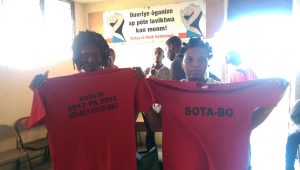
    By law, the minimum wage is supposed to be adjusted annually for inflation. It has not been adjusted in three years. In the press conference video above on Tuesday, February 22nd, Telemark Pierre of the union SOTA-BO, explains that the workers do not accept the government’s offer, and that the workers will continue to mobilize.

    Pierre also exposed factory owners’ level of theft and exploitation in speaking to the press. The brands produced in Haiti, like Gildan, Hanes, Fruit of the Loom, UnderArmour, Gap, and Walmart pay Haitian factory owners like Clifford Apaid, Charles Baker, and Alain Villard in US dollars. The owners pay workers in Haitian gourdes, meaning they instantly pocket a profit in this exchange. On top of this, Haitian workers receive the lowest wage in the western hemisphere, allowing factory owners to make millions of dollars in profits. The brands make billions. The money is there for a meager 1500 gourdes per day (less than $15 USD PER DAY, not per hour).

    Factory owner Clifford Apaid is one of the 10 richest people in Haiti. He comes from one of Haiti’s most powerful families, dominates the factory owner lobbying group, the Association of Haitian Industries (ADIH), and also holds a level of power over the interim prime minister, Ariel Henry. Despite the immense level of his personal (about $350 million USD) and family wealth, he leads the effort of factory owners to resist wage adjustments and increases, along with consistently repressing workers’ legal right to organize.

    In the above video, the woman yells to the police:

    “What we, the workers, are demanding is just! You should not be teargassing us. These are your mothers out here! You can’t do that! The only reason you are able to stand here today as a police officer is because you had a mother who worked in a factory! These are your mothers!!”

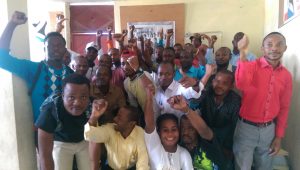
    The workers hold broad support from neighborhood associations, human rights organizations, progressive political organizations, economists, street merchants and vendors, and even some politicians. Thousands of people have filled the street as workers or supporters of their demands. This is significant, as there have not been mobilizations of this scale in Port Au Prince since the assassination of former president Jovenel Moise and the increased power and violence of street gangs who control much of the city.

    These workers have contributed to a shift from fear to fighting back. Many people, besides the workers, have been in the streets to make sure that the mobilizations can continue, contributing to blockading streets, sending tear gas canisters back to the police, protecting each other from arrests and police attacks.

    This struggle is one we can all relate to. Across the US, workers and laborers are going on strike and organizing for better wages and working conditions. Around the world the people are struggling to keep up with costs of living as corporations see record profits. We can learn from the example of Haitian workers’ unrelenting struggle to organize and fight against domination and exploitation. When we are all organized, international solidarity truly comes to life!

    February 17th, 2021 REUTERS/Ralph Tedy Erol
    February 17th, 2022 REUTERS/Ralph Tedy Erol

    The RRN has received reports that the strike and march attempted for today, February 24th, was dispersed before it could start. Police surrounded the Sonapi Industrial Park, the regular starting point of marches, firing gun shots into the crowd. But, the struggle is not done…  because their fight is just, and their demand is a dire necessity. Some workers have been fired for their union activity. More firings are expected. Paychecks will be short because of the time off of work.

    If you can lend solidarity in the form of a donation for workers struggling to both eat and keep the fight going, it is much appreciated. The RRN works with the trade unions affiliated with the independent Haitian workers movement, Batay Ouvriye (BO). SOTA-BO is the union in Port Au Prince that has been at the forefront of this current mobilization. Your donation will be sent directly to Haiti to support these union members.

    Click here to DONATE.

    PS:  Thank you again if you gave during the Summer/Fall 2021 fundraiser to help Haitian workers and peasants with Batay Ouvriye continue organizing! Your donations provided important funds to help workers meet costs of living and for meetings to continue happening among workers and peasants. Can you spread the word to friends, family, coworkers, classmates to tell them what’s going on and ask them to lend their support?

    Thank you for your Solidarity!

    Kenbe Fem/Stay Strong
    Batay L’ap Kontinye/The Struggle Continues
    Mesi anpil/Thank you very much!


  • Help Raise $10,000 for Haitian Workers Facing Chaos

    Help Raise $10,000 for Haitian Workers Facing Chaos

    July 2021 – In the wake of the assassination of corrupt Haitian president Jovenel Moise, politicians fight for power over a broken system that has never benefit Haiti’s workers, peasants and the poor. Gangs control much of the country, especially in the capital city, Port Au Prince, where they are known for burning neighborhoods, murdering, kidnapping, robbing and ransacking homes.

    In the midst of this turbulence, plus already existing struggles, the Haitian workers movement, Batay Ouvriye (Workers Fight), continues their steadfast fight to gather, organize and build the power of those who are dominated and exploited.

    The Rapid Response Network is raising funds to make sure they can continue their mission, even through the current chaos and dangers.

    Please help us raise $10,000 to support the workers and peasants of Batay Ouvriye (BO).

    You can also scroll below for more info on the situation & how funds will be used.

    MORE INFO ON THE SITUATION IN HAITI

    Since 1994, Batay Ouvriye has been building a nation-wide workers’ movement. They organize textile workers and informal workers (street vendors) in the cities and peasants and agricultural workers in the rural areas of Haiti.

    In the capital city, Port Au Prince and just to the south in the town of Carrefour, there are chapters of the BO affiliated union SOTA – Sendika Ouvriye Teksti akl Abiman/Union of Textile and Apparel Workerse. SOTA-BO fights for workers’ increased wages, basic rights and against union busting and sexual harassment in factories. Textile workers receive less than $5 USD per day, the lowest wage in the western hemisphere, to sew the t-shirts, socks, activewear and pandemic masks that we consume in the US and Canada.

    Workers were already struggling to exist based on these miserable wages. Since the pandemic, production has been severely reduced, leaving workers with no way to pay bills, send their children to school, and feed their families. To make things worse, in the last year gangs have established a strong hold in the neighborhood of Martissant, located between Carrefour and Port Au Prince. They have effectively blocked the flow of materials, money and goods to and from the southern region of the country. This means even less work for garment workers and often major delays in receiving their paychecks.

    These bottlenecks and breakdowns are accompanied by the burning down of homes and neighborhoods, robbery, kidnapping and near daily massacres by the gangs. As a result, many workers have been forced to temporarily abandon their homes. Many are staying in temporary housing set up by NGOs. When workers brave the streets to go to work, or attend organizing meetings, they often arrive hungry, without transit fare to get back to their families who anxiously await their safe return.

    In the rural areas peasants with BO are organizing to resist aggressive land grabs and privatization that eliminates their existence as subsistence farmers and forces them into the cities in search of work that is already in very short supply. Rich Haitian families are violently evicting peasants, hiring police and gangs to brutally assault and force them from their land and livelihoods. Much of this land is then being used to build housing and to develop agribusiness and mining. Some companies that are already present due to these land grabs include Coca-Cola and Heineken.

    CLICK HERE TO DONATE.

    How Funds Will Be Used:

    • $5,000 – rent for one year for the Batay Ouvriye office and meeting space in Port Au Prince. Without fair or living wages, workers have no funds to contribute to maintaining their space. This office is incredibly important not just for meetings, but as a safe place to be off the streets. The office is close to the SONAPI Industrial park where many of them work (when work is available), and where they can more easily access transportation to get back to their homes or temporary housing.
    • $1,500 – three meetings for BO peasant organizers. Each of these meetings costs $500 to provide a meal and transportation costs for all attendees. At these meetings organizers from across different regions travel great distances, sometimes on foot, so they can gather to plan and coordinate their efforts.
    • $500 – general assembly of delegates from various peasant organizations from different rural regions. They will meet to evaluate what they’ve accomplished in their efforts to organize small and landless peasants, and form a coordinating body to guide their future work.
    • $3,000 – solidarity funds for textile workers in the Port Au Prince and Carrefour area who are out of work and also temporarily displaced. Many of their homes are inaccessible, blocked by gang strongholds and extreme violence. Many are staying in temporary shelters set up by NGOs or staying with friends. These funds will provide some temporary, emergency funds for workers to temporarily subsist. Funds may be used to buy food, pay schooling costs for children, transit fees,

    Every donation counts and has a BIG impact. For some perspective, here are some suggested giving levels and what your donation can pay for.

    • $36 – pays for about three days of breakfast, lunch and dinner, plus transit costs in the city for one worker.
    • $60 – covers transit costs for about 12 peasants to attend a meeting in the countryside.
    • $125 – pays for 275 pounds of rice and 5 gallons of cooking oil to distribute to workers.
    • $360 – can cover the school enrollment fee for four elementary school children.
    • $500 – covers meals and transit costs for an entire peasant meeting.
    • $1,250 – covers three months of rent for the Batay Ouvriye office in Port Au Prince.

    Please choose what you can give, and lend your solidarity to these brave folks who continue to fight for a better world.

    PS:  If you’ve donate to past RRN campaigns, thank you so much! We hope you’ll give again as these funds are desperately needed. Or, if it’s just not possible, please help us spread the word. Thank you again.


  • Support Workers in Their Fight Against Stolen Wages, Denial of Medical Care!

    Support Workers in Their Fight Against Stolen Wages, Denial of Medical Care!

    While people all over the globe have been forced to face the challenges of COVID-19, workers at several of Alain Villard’s garment factories in Haiti are particularly vulnerable to the virus and its effects. The death of Sandra René, a decade-long employee of Palm Apparel in Carrefour, exposed the bald corruption of Villard when OFATMA – the state insurance provider – refused to cover Sandra’s care. Despite ten years of biweekly paycheck deductions to cover healthcare, Sandra’s insurance card was invalid – not only had Villard not paid a cent of insurance payments to OFATMA for three years, he had also neglected to pay tens of millions of gourdes in medical bills. Villard has been pocketing the insurance payments despite the fact that he receives customs tax breaks under the HOPE Act on the condition that he provide social security and health benefits to workers.


    signal-2020-08-02-112350


    When Sandra was turned away from Carrefour Hospital Center, her family approached Palm Apparel for a loan which would be paid back through Sandra’s wages – much like the stolen insurance payments. Palm Apparel refused to administer the loan. Her family struggled to raise the funds for her necessary treatment, but Sandra died at home four days later. She was six months pregnant with her first child. Her medical expenses amounted to around six hundred U.S. dollars.

    Sandra René’s funeral procession escalated to a spontaneous protest when her casket was brought before the OFATMA office. She is not the only worker to have died from this disgusting display of severe exploitation – Pierre Lunel was also denied life-saving dialysis treatments, killed by multiple layers of bureaucratic negligence and fraud. Several different calls for restitution have come from the families of the victims as well as workers and their unions. The callousness and moral bankruptcy of Villard, OFATMA, and other bureaucrats in Haiti result in such wide-spanning expressions of corruption, workers are divided on what to strike in opposition to – years of garnished wages amounting to nothing, the complete failure to provide the services they paid for, or their continued exploitation and domination.

    Workers were already coping with the loss of wages brought about by COVID-19 factory closures, and are now in need of supplies for their children’s schooling. Even before work stoppages due to COVID dangers, these workers made little more than what it costs to get them to and from work. Sandra’s medical costs amounted to what some people in the U.S. pay per month for a car payment and insurance. While these workers fight for the services they’ve been robbed of, our solidarity and support can make a significant difference in their survival and ability to combat their own exploitation and domination by Villard and those like him.

    You can donate directly to workers here. Most worked 6 days a week prior to COVID-19. The daily wage for workers is around $4, considering recent inflation; $24 can replace a week’s salary for a worker illegally fired, or for someone trying to stay home to protect their family from COVID; $100 can take care of a month’s salary so workers and their families can eat. Funds from donations will be used not only in supporting worker’s needs, but also in galvanizing those in factories in Port-au-Prince, Caracol, and Ouanaminthe, who must fight against wage theft as well. Every dollar makes an impact!

    We will also be launching pressure campaigns based on the struggles of workers organized through SOTA-BO. By speaking directly to the people and institutions stealing from and repressing workers, we have the opportunity to demonstrate international support for justice and restitution. Below are sample email templates that center the demands of workers depending on the distinct players: OFATMA, Villard, and MAST, the ministry in charge of paycheck deduction oversight.

    Sample Email to Agabus Joseph, Director of OFATMA

    Sample Email to Nicole Yolette Altidor of MAST

    Sample Email to Alain Villard, Palm Apparel and Sewing International SA owner

    We can play a role in finding justice for the family’s of Sandra René and Pierre Lunel. We can play a role in resisting years of wage theft from workers who make our most basic necessities. Please consider donating and getting involved!