Author: Editor1

  • Haitian Workers Shutdown Factories

    October 2025

    Insecurity continues in Haiti. On February 7, 2026 the current transitional government’s term ends. This temporary administration aimed to hold elections before this end date, but this is unlikely.

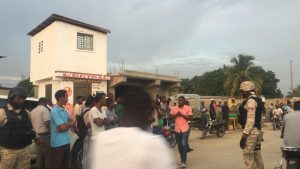
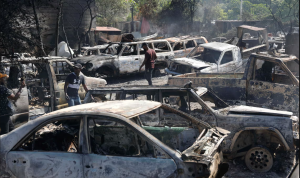
    There are two departments (similar to states in the US) in Haiti that hold the most votes – The West and Artibonite. These are also the areas most plagued by gang violence with homes being burned alongside regular shootings, and the rape of women.

    “On 30 September, the UN Security Council authorized a new multinational Gang Suppression Force (GSF) in Haiti to replace the Kenyan-led security support mission, amid escalating gang violence, widespread rights abuses and a humanitarian emergency affecting all aspects of life in the island nation” (United Nations). The Haitian transitional leadership hopes this new military group will be able to suppress the gangs to allow for elections, but they have yet to arrive in the country.

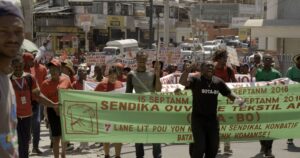
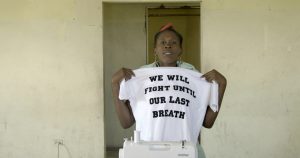
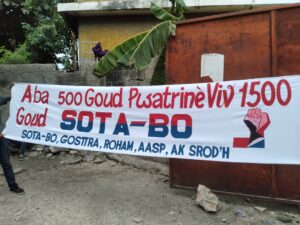
    Meanwhile, anger and frustration are high, particularly among workers as gang violence and overall instability blocks them from working while they struggle to stay alive. On September 25, 2025, in Port Au Prince, garment workers and members of the Batya Ouvriye affiliated union, SOTA-BO, held a sit-in, in front of the Prime Minister’s office and the Council of Presidential Transition (CPT), demanding increased wages. Mobilizing like this is a greater risk in the capital city as this is the apex of gang activity, showing how desperate these workers are for change.

    In October 2025, in Ouanaminthe at the CODEVI Free Trade Zone, workers shut down the industrial park. At their meeting with government officials, workers warned officials that they need to come with ways to increase, not decrease production. Further, they put forward that this production should benefit the Haiti and its people, rather than being purely extractive, as is the current arrangement.

    HOPE/HELP?

    On September 30, 2025, the day before the longest US government shutdown in histtory, the Hope and Help Acts expired. These laws allow textiles produced in Haiti to enter the US and Canada mostly tariff-free.

    Production in Haitian industrial parks has decreased drastically as gangs terrorize neighborhoods, control roads, highways and ports, making factory production increasingly difficult for workers’ safety and manufacturers’ operations.

    Apparel accounted for over 90% of U.S. merchandise imports from Haiti. The apparel sector also provided over 60,000 jobs in Haiti in 2021, though this number declined to nearly 22,000 by 2024 due to political instability and security concerns.

    A representative of Batay Ouvriye told the RRN that as of October 2025, CODEVI Free Trade Zone is the biggest operation right now with 20,000 workers. At SONAPI industrial park in Port Au Prince there are less than 5,000 workers right. At Caracol Industrial Park in Cap Haitien there are about 2,000 workers.

    In a country as dominated by imperialism as Haiti, brands and manufacturers want everything – land, infrastructure, workforce, and they want it cheapest, but ideally free. If they don’t get their way, they pack up and leave. When you add gang violence to the loss of duty-free imports to the US, global brands are even more likely to leave the country. The current global economy is arranged to facilitate corporations’ ability to globe-hop to wherever labor is cheapest, regulation is non-existent, and taxes and tariffs are minimal. Companies extract, exploit, and put nothing back into the country and people where goods are made.

    In this tense situation, Haitian manufacturers, on behalf of global brands produced in the country continue to try to squeeze workers for additional profit, and the trade unions affiliated with the workers movement Batay Ouvriye have hit a boiling point.

    BO vs. CODEVI

     CODEVI Free Trade Zone is located in Ounaminthe, a city in the northwest region of Haiti, bordering the Dominican Republic. CODEVI a Haitian company, owned and managed by Dominican company, Grupo M.  The industrial park mostly produces textiles. Here’s a list of the brands produced at CODEVI:

    Old Navy, Fruit of the Loom, Levi’s, GAP, Dockers, Liz Claiborne, Polo, Hanes, Calvin Klein, Columbia Sportswear, Levi Strauss, Lucky Brand Jeans, Nordstrom, Dillard’s

    Since 1994, Batay Ouvriye (Workers Struggle) has been building a nation-wide workers’ movement. They organize textile workers and informal workers (street vendors) in the cities and peasants and agricultural workers in the rural areas of Haiti.

    Inside CODEVI there are several BO-affiliated unions including:

    • SOKOWA-BO
    • SEDOC-BO
    • SOTECO-BO
    • SYNTRAC

    Shutdown of CODEVI

    Article 107 of the Haitian Labor Code says if a worker works 48 hours per week, or six days per week, they should get paid for a rest day on Sunday. Management at CODEVI has not complied with this article for years. The BO unions pressured them to comply. CODEVI agreed to begin applying Article 107 on October 6, 2025.

    However, they also said that they would now begin taking 20% tax from workers’ paychecks. These are taxes the employer is responsible for paying to the government towards a fund that pays workers for extra hours and for the paid holiday during the month of December.

    Prior to this round of negotiations around Article 107, CODEVI was paying these taxes. But when the workers asked for the paid rest day that is legally owed to them, CODEVI tried to shift the cost of these taxes onto the workers.

    In response, on October 6, 2025, the workers of CODEVI, led by BO unions, walked out of their respective factories, shutting down production. The same occurred the following day.

    On October 8, 2025, workers met with government officials including the Minister of Finance, Minister of Labor, and Minister of Economy & Industry. These officials agreed to temporarily pause collection of the taxes, protecting CODEVI, and pushing workers to resume their jobs in the factories.  But, the workers said no based on being disregarded in the negotiation process. The workers were included in this meeting, but their items were not included in the formal meeting agenda. So workers shut down CODEVI again with walkouts and work stoppage.

    Monday, October 13, 2025, CODEVI requested a temporary suspension of operations for one month from the Ministry of Labor from October 13th through November 7th, meaning workers would be out of work this entire time.

    Two days later on October 15th, CODEVI reneged on this suspension of operations. Instead, they put out a letter telling workers to get back to work. The government put out a statement saying it will withdraw both taxes, but no word about the minimum wage.

    Workers’ Demands

    • No more taxes
    • Publish a new minimum wage adjustment
      • Article 107 of the Haitian Labor Code also states that whenever there is a 10% increase in inflation, the government is supposed to adjust the minimum wage. They have not adjusted the wage since April, 2022. The inflation rate is currently around 40%.
      • Workers are demanding 2,500 gourdes/day (about $19 USD/day)
    • Social Benefits
      • There is a loan from the world bank the Haitian government can use to address social needs. This program will be over in 2026. Workers receive about 1500 gourdes from this fund at the beginning of each school year for back to school costs. This has been occurring for two years. Workers want a similar program to continue
      • Housing – affordable units with rent to own programs
      • Education costs – books, tuition, etc.
      • Transportation – subsidized for workers to commute to and from home and the factory
      • Subsidized meals and basic food goods in the industrial parks
    • Increase Production for Haiti & Haitians
      • At their meeting with government officials, union organizers pressed officials for increased production that benefits the country and its people with economic and social investment in Haiti and Haitians.
         
  • Gang Violence, Chaos in Haiti – Why?
    Gang Violence, Chaos in Haiti – Why?

    The Rapid Response Network has been offering solidarity from the US and around the world to support Haitian workers and peasants organized with Batay Ouvriye since 2012. This has often taken the form of pressure campaigns to amplify the voice and demands of workers and peasants against major global brands, factory owners, and big landowners in Haiti.
    Now with the ongoing gang violence and total economic destruction by the gangs with the shutting down of key shipping and airports, factories have mostly shut down. Workers are being laid off with zero certainty of when they may work again. It’s incredibly dangerous to move on the street. Peasants trying to work the land in the countryside are also facing attacks from gangs. Food is scarce and the prices are astronomical. Workers, peasants and their families are facing possible starvation.

    In all the chaos occurring, it’s overwhelming to figure out how this moment came to be.

    Below is a report from a contact who has regular communication with BO. They compiled this summary report to give some contextual information and history to understand this moment.

    It’s long, but we hope you’ll give it a read. It’s worth your time.

    Last, Please Consider a donation of $25 or more to support Batay Ouvriye members.

    They need financial support to make it through this time, because they are determined that their fight is not over.

    Batay L’ap Kontinye – The Struggle Continues – Solidarity Forever.

    CLICK HERE TO DONATE. <3


    HOW DID HAITI GET TO THIS POINT OF ANARCHY? 
    A history of Destabilization

    Note:  To gain some understanding of the current situation in Haiti, one must understand some of the historical developments that led to this moment of complete instability. This overview of what’s happening in Haiti begins in 1986. But you could go back further for a deeper understanding of how imperialism has continually dominated and destabilized Haitian economy and politics, particularly the workers and peasant political struggles and movements.

    Rampant gang violence is a major feature of the news on Haiti these days, although it is a relatively recent development. The rise of gang rule in Haiti originated in the post-Duvalier years, after 1986, with the disbanding of paramilitary forces and the Haitian army, and persistent political instability. This also coincided with the expansion of narcotrafficking networks using Haiti as a major unregulated transit point with the help of some government cronies. This was compounded by the expulsion and repatriation of Haitian immigrants jailed in the US for various crimes.

    Each successive administration built its own network of armed supporters in poor neighborhoods to consolidate their power and influence elections. Contending political parties established their own bases of armed supporters and integrated them into various illicit trades. Major business owners, like Mews, Madsen, Acra, Bigio, and Boulos, also propped up gangs and private security forces to protect their businesses and attack their competitors.

    In some poor neighborhoods, self-defense resistance committees (“brigad vijilans”) that were setup during the coup years against Aristide (1991-94) eventually devolved into gangs that took over control of their areas, as the Haitian state was systematically weakened through neoliberal reforms and the police forces rendered more ineffective.

    This rising influence of gangs is a complex phenomenon, intimately linked to the failure of neoliberal reforms imposed through imperialist domination, such as free trade policies that devastate the local economy because of cheap imports, austerity policies that impose cutbacks on all social services and incapacitates the state, policies promoting low wages and cheap labor that impoverish working people, privatization of state run enterprises that further reduce state budgets and render them more dependent on foreign funding, deepening odious debts incurred by US supported dictatorships, all of which serves to deepen imperialist domination and the misery of the poor masses.

    The rise of gangs is not unique to Haiti and has seen parallel developments in many countries like in Jamaica, Honduras and narco-states like Mexico and Colombia. It is also linked to the expanding illicit international arms trade sponsored by the endless imperialist wars and the arms trafficking linked to these conflicts. The gangs come to rule through the absence of the weakened state.

    2010:  Earthquake & US “Aid.” UN “Peacekeepers” bring Cholera. Plus, a Hurricane.

    On January 12, 2010, during the last year of René Préval’s lame duck presidency, a massive 7.3 magnitude earthquake struck Haiti and killed an estimated 200,000 to 300,000 persons, (over 2% of Haiti’s population), mostly in the capital’s metropolitan area, leaving hundreds of thousands homeless. The earthquake that was popularized as “goudou-goudou” also laid waste to most of the capital’s infrastructure, including most government offices.

    The US spearheaded the international response by taking over the main airport, prioritizing the deployment of about 20,000 troops to maintain control, and organizing the distribution of aid at gun point. This militarization of the aid meant that most of the effective rescue efforts were led by the local population mobilizing the meager resources that were still available, mainly with bare hands and shovels.

    The Obama-Biden-Clinton administration appointed Bill Clinton as an overseer of aid distribution and over $5 billion in international aid were funneled through a vast network of hundreds of mostly US based NGOs to bypass the Haitian government and “prevent misappropriation”. This resulted in massive fraud, corruption and inefficiency profiting mostly the NGOs, with an estimated 5¢ on the dollar reaching aid recipients.

    The US troop deployment was phased out and replaced by beefing up the existing UN MINUSTAH mission to keep the lid on a potential exodus of immigrants seeking refuge in the US. A newly deployed Nepalese contingent of UN “peacekeepers” introduced cholera to Haiti, resulting in an epidemic that led to the death of about 10,000 and the infection of about 800,000 persons.

    On November 9th of that same year, in 2010, Hurricane Thomas struck Haiti, displacing hundreds of thousands and worsening the already bleak situation.

    Those are the circumstances in which the US pushed through the holding of elections on November 28, 2010, in order to replace the Préval administration that had been meekly stalling and pushing back on neoliberal reforms: the earthquake aftermath with hundreds of thousands still living in makeshift tents, a huge cholera outbreak, and a devastating hurricane.

    The US then coerced the crippled Haitian government into changing the election results to promote its favorite candidate, Michel Martelly, to the second round of elections, which he eventually won with a turnout of 20% of voters. Michel Martelly, a popular musician, a depraved, confessed drug dealer and FBI informant, was the US choice to implement its “Haiti is open for business” policy, a featured example of “disaster capitalism”, with much more disaster than capitalism.

    The US-backed Martelly administration fully opened the gates to neoliberal reforms while greatly expanding the institutionalized corruption of the Haitian state, narco-trafficking, contraband trade and the promotion and expansion of government affiliated gangs. It also postponed elections at all levels and resorted to political appointments and vacancies to establish control of all 3 branches of government, ultimately ruling by executive order.

    The accelerated ongoing degradation of the Haitian state, economy and social structures can be traced back to these policies.

    Jovenel Moise: Accelerated erosion of Economy, State. Growth of Armed Gangs. Assassination.

    Although elections were held in November 2016, the newly elected president, Jovenel Moise, was hand-picked to serve as a puppet to Martelly’s governing PHTK (bald head) party and its affiliated bureaucratic and comprador bourgeois fractions (those who wield state power as a source of enrichment and those who profit from import-export trade and the assembly manufacturing sector).

    The Moise administration continued with the same policies that fostered the accelerated degradation of conditions overall and the spread of armed gang violence, resulting in large widespread demonstrations, particularly in 2019, demanding that he step down. Despite massive protests, Jovenel held on to power 5 months beyond his constitutional mandate, because he had the support of the “international community”, mainly the “Core Group” (US, France, Canada, Brazil, Mexico, Spain, Germany, the OAS, the UN, and the EU).

    Internal strife within the ruling PHTK party led to Jovenel’s assassination on July 7, 2021, by a squad of mostly Colombian mercenaries. Claude Joseph, the acting prime at the time, was soon replaced by Ariel Henry who had just been nominated by Jovenel to replace him. Claude was replaced by Ariel through a Tweet from the US Embassy, officializing “Core Group” support for Ariel. Ariel Henry was the leader of the opposition that deposed then president Aristide in 2004 and forced him into exile.

    Ariel’s appointment as prime minister was entirely outside of Haitian constitutional order since there did not exist a parliamentary quorum to ratify his appointment nor a head of state to officialize it. That is why he was often referred to as a “de-facto prime minister”. Ariel’s supposed mandate was to organize new general elections that would replenish the vacated office holders whose terms had expired. However, by refusing to compromise the domination of the ruling PHTK party, all the political negotiations to hold new elections failed in stalemates.

    Ariel’s main achievement was staying in power for 21/2 years while riding out ever growing waves of protests demanding he step down. He ruled by decree during these 21/2 years, overseeing an increasingly chaotic and anarchic situation that saw the proliferation of gangs and extreme depraved violence against the population, such as gang rapes of girls and women, rampant kidnappings and extortion, public burning and dismembering of bodies, instances of cannibalism, massive dislocations of hundreds of thousands in poor neighborhoods fleeing this persecution, the division of the capital’s metropolitan area into subdivisions of gang-controlled areas cutting off and restricting traffic on the main highways and roads, imposing check points and tolls on public roads.

    The reigns of terror established by these local gangs were propped up by this wanton depraved violence, as the gangs continued to be financed by various factions in the government, the bureaucratic and the comprador fractions of the bourgeoisie and their networks of contraband and drug trade. Although the extreme violence perpetrated by these gangs also reached some members of the ruling classes, their most important strategic effect was to quell public and mass demonstrations, filling in for the weakened police forces.

    Viv Ansanm:  Gangs Take Full Control

    Notwithstanding this rule of terror, the popular masses of Haiti sustained several month-long and week-long mobilizations, “peyi lòk” (locked down country), similar in effect to general strikes. There were also several worker-led mobilizations organized by Batay Ouvriye of several thousand assembly sector workers and some students to demand an end to the insecurity and an adjustment to the minimum wage while facing tear gas and live bullets from the police. These remarkable achievements in such dire circumstances failed to account for the fact that the ruling classes have far more reserves than the masses and control the repressive forces, highlighting the limits of peaceful resistance.

    The autonomy of most of these gangs expanded as they grew less dependent on their sponsors and relied more and more on ransoms, kidnappings, extortions, contraband, arms, and drug trade.

    In November of 2022, Ariel appealed to the UN Security Council to intervene in Haiti, ostensibly to restore the rule of law and to put down the gangs, but mostly to shore up his flailing authority.

    It took about a year for the UN Security Council to reach a compromise Title 7 agreement to sanction a non-UN police assistance force (MMAS – Multinational Security Assistance Mission) led by about a thousand police from Kenya, mostly funded by a $200 million yearly grant by the US.

    As this agreement was stalled in Kenya due to constitutional technicalities, Ariel Henry traveled to Kenya, prompted by US diplomatic efforts, and signed an agreement on March 1, 2024, to resolve these. However, Ariel’s attempt to return to Haiti on March 3 was foiled by the uprising of the gangs that blocked the airport and the Dominican Republic’s sudden refusal that Ariel’s plane land in the DR, forcing Ariel to land in Puerto-Rico.

    During Ariel’s trip abroad, there was a loose coalition-alliance, calling itself “Viv Ansanm” (Living Together), formed by most of the gangs in the capital’s metropolitan area, prompted by the government’s attempt to mobilize foreign forces against them. They coalesced to demand Ariel’s resignation, and to attack and take over police stations, strategic infrastructures, and government offices. They have succeeded in these objectives for the most part, although the main airport and the police training facility are still under siege and not yet in their control.

    This upheaval prompted the “international community” to dump their support for Ariel Henry and call for his resignation. Ariel put out a resignation video on March 11, in concurrence with US demands to set up a provisional ruling council of 7 qualified representatives from several political parties and the business sector. These qualifications include that they must support the deployment of foreign troops to Haiti and that they must not have been previously convicted of felonies.

    This coalition-alliance and stunning sudden apparent shift in gang activity, from depraved massacres and infighting warring for territorial control by gangs flaunting their viciousness to a “Living Together” rebranding of these same gangs to “’armed groups” suddenly wearing military uniforms cannot be easily explained. What could make these warring sworn enemies suddenly coalesce to join forces and collaborate in a political struggle?

    One possibility is that there is a controlling force supplying these gangs with guns and munitions that has brought this about. A plausible but unconfirmed possibility is that international drug cartels are trying to maintain an anarchic situation in Haiti that facilitates their operations. “Viv Ansanm” has stated that whoever comes to power in Haiti would still be beholden to them. This would be consistent with recent political events, including the assassination of president Jovenel Moise in 2021. It is also plausible that the gangs are negotiating for amnesty and integration into the newly reinstated Haitian armed forces, while facing the impending threat of foreign forces.

    BBQ & Gangs Do Not Represent the People’s Interests

    Much has been made of the apparent self-declared leader of the “Viv Ansanm” coalition, Jimmy Cherisier, aka “Barbecue”, a former police officer implicated in various massacres in popular neighborhoods. Cherisier, a leader of the former “G-9” UN sponsored gang coalition, has consistently denounced the inequalities of Haitian society, blaming a few in the Haitian oligarchy for the misery of the masses. He also has consistently claimed the legitimacy of armed resistance to injustice while, unlike other gangs, renouncing acts of persecution of people, such as kidnappings and rapes, in the areas controlled by gangs in the G-9 coalition.

    He has repeatedly claimed that he is leading a revolutionary movement to right these injustices, while also publicly mourning the assassination of president Jovenel Moise, clearly implicated in them.

    However, these claims belie the fact that the G-9 control strategic infrastructures like the main petroleum receiving port and the use of this control to leverage numerous exactions to fund their operations. He has also publicly acknowledged responsibility for several massacres involving rival gangs while calling for reconciliation with them. He has also publicly acknowledged his previous affiliation with part of the same oligarchy (Boulos) that he currently denounces. Where did the guns and the money come from?

    The claims of popular revolutionary aspirations conflict with reality. Barbecue has successfully positioned himself into a populist negotiating position in the current unfolding of events as a spokesperson for the sponsors and behind-the-scenes controllers of the gangs.

    Proposed Political “Alternatives”

    This political positioning is in alignment with an attempt to establish a 3-person provisional governing council, headed by Guy Philippe, a released convicted drug dealer, former officer of the Haitian army, who led the 2004-armed putsch that deposed Aristide, and a former Haitian senator. This is part of a coalition with the “Pitit Desalin” (Sons of Dessalines) political party headed by Moise Jean Charles, a populist political figure in the opposition camp to Ariel Henry. This Guy Philippe option has garnered significant popular support in street demonstrations and is to date leading in-country mobilizations.

    On the other hand, it seems that US-led diplomatic efforts, through CARICOM, to impose a 7-person ruling council that would select a new prime minister, are facing increasing opposition in Haiti.  Haitian political parties have yet to agree on the composition of this 7-persosn ruling council and are seeking to delay their nomination.

    The gangs in the “Viv Ansanm” coalition, acting like a paramilitary force, have effectively taken control of most strategic positions and sacked most police stations, many banks, major car dealerships and government offices, as well as public institutions, universities, hospitals, and private residences, reinforcing a state of anarchy. Various rumors spreading like wildfire are provoking panic in the streets. The Kenyan deployment of a thousand police has been put on hold until the political situation has been stabilized.

    The Biden administration has publicly renounced deploying US troops to intervene in Haiti, as that would be a major tactical vulnerability in an election year. Special forces have been deployed to secure the US embassy, the fourth largest US embassy in the world, while US citizens have been urged to evacuate.

    The US administration is also considering using Guantanamo to once again jail Haitian refugees apprehended trying to seek asylum before reaching US shores. The specter of a flood of poor black refugees reaching Florida in an election year seems to be a key factor determining US policies toward Haiti. As such there seems to be little differentiating Trump’s position on Haiti as being a “shithole country” and Biden’s statement that if Haiti were to disappear and sink into the sea it would be of little consequence to the US.

    The situation in Haiti is extremely chaotic and the unfolding of events is very unpredictable. It seems like the US has lost some of its leverage while the state of anarchy is becoming more entrenched, giving the gangs and their sponsors more power, while the overall situation becomes more and more unlivable for the masses.

    Although the imperialists are attempting to use the UN, CARICOM, the OAS, and foreign troops to reinforce their domination, they are struggling to come up with a viable alternative. Something will have to give at some point, probably in an explosive manner, to resolve these contradictions, even if in an unconclusive temporary manner.

    Impacts on the People

    About two thirds of the assembly sector workforce has been laid off due to the sanctions imposed by the “international community” and the prevailing security crisis. Several factories have closed down, and most of the remaining factories are operating with reduced hours and cutbacks in production. Workers are facing increasing difficulties just surviving day to day, navigating the exorbitant cost of living, dodging bullets and the insecurity.

    Gang violence has also severely affected most people living in poor neighborhoods and rural areas. Hundreds of thousands have been forced to flee their neighborhoods because of massacres and indiscriminate shootings, rapes, and the burning down of their homes as various gangs competed to take over each other’s territories or to expand into new territories. Schools have been shut down for extended periods, people dealing in small trade (“ti machann”) have been forced out because the roads they use for purchasing and transporting their goods are blocked by the gangs or their goods have been stolen. The prices of most common goods have skyrocketed due to their scarcity. Corrupt officials in rural areas have used gangs to expropriate small farmers and to repress their calls for justice. Organizing efforts of poor peasants and rural day laborers have come under increasing repression and also face perilous, sometimes prohibitive conditions.

    Call for Support

    These dangerous and difficult conditions call for greater resolve and combativity, even while the prospects of immediate relief remain distant.

    BO is not in a position to lead mass mobilizations and resistance because it faces brutal armed violence of the gangs and the police. This is a defensive moment to preserve our organizations and movement, to consolidate our efforts while trying to grow them in these perilous conditions.

    Even if it is subdued for the moment, there will always be uprisings and mass protests by the people against their domination and repression.

    We call for the solidarity of those who believe in the struggles of workers, exploited laborers, and the oppressed masses to organize to build a better world. We ask you to spread our message as we send you our solidarity to you in your own struggles.

    We have nothing to lose but our chains.

    Please Consider a donation of $25 or more to support Batay Ouvriye members.

    They need financial support to make it through this time, because they are determined that their fight is not over. Batay L’ap Kontinye – The Struggle Continues.

    CLICK HERE TO DONATE.

  • Haiti Update + Call to Organize

    Haiti Update + Call to Organize

    March 14, 2022

    • As Haitian garment workers continue to fight for their rights, we in the US can learn from their example of independent organization.
    • What follows is an update on the recent strikes in Haiti for increased wages, and a call to build independent organization here in the US.

    UPDATE

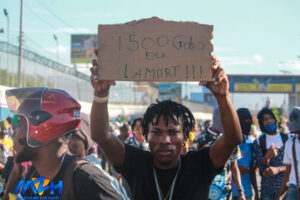
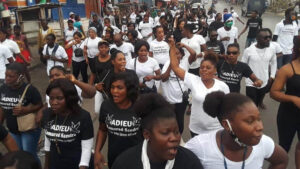
    In the last days of February 2022, Haitian garment workers were brutally repressed for taking the streets to demand an increased minimum wage of 1,500 Gourdes per day ($14.81 USD). On February 23rd, one reporter was shot and killed, with two others shot and several injured. You can read more about that update here.

    Learn more about the historical context of Haitian garment workers’ continued fight for wages.

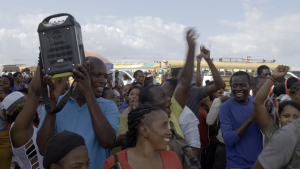
    In the days that followed this atrocity, workers continued their mobilization effort. On Thursday, February 24th, workers gathered in their usual location outside the Sonapi Industrial Park on Airport Road in Port Au Prince. As they waited for their sound truck to arrive, police opened fire on the assembled workers and their supporters, forcing them to disperse. Angered and undeterred, the workers gathered again outside the park the following day, Friday, February 25th. This time, they were attacked inside the industrial park with teargas when they attempted to gather more workers to join them. In response workers took the streets outside the park, burning tires and blocking the road.

    These days of mobilization were in response to the government’s insulting wage adjustment of 685 gourdes per day ($6.50 USD), far from the workers’ demand of 1,500 gourdes ($14.81 USD). In their announcement on February 21st, the government also said they would offer lunch and transportation subsidies for workers. (Transportation to and from work costs about 200 gourdes per day.) But, no details or timeline about how or when these programs would be implemented.

    "For 1,500 Gourdes without increased quotas!"
    “For 1,500 Gourdes without increased quotas!”

    The government also stayed quiet on the issue of production wages. In addition to the legal minimum wage set by the state, factory owners set a production wage based on a quota system. If workers reach their quota, they receive an additional wage above the minimum wage, sort of like a bonus… except even with this “bonus” their wages do not meet the costs of living. While this production wage is set by the private manufacturers, the government is supposed to also put forward a fair and legal suggestion of what this wage should be based on costs of living, inflation, etc. The government’s silence on this issue allows factory owners to continue their normal practice of setting quotas impossibly high, so that they never have to increase workers’ pay.

    Additionally, workers who participated in the strike and mobilization continue to be illegally fired and harassed at work. If the unions are not present to push back, union workers become eliminated and blacklisted from work in the industrial parks.

    Given this context, SOTA-BO in coalition with four other unions is shifting gears from the streets to dealing with firings, fighting factory owners on the production wage, and pressuring the government to follow through on their mention of subsidies. The unions told the prime minister, Ariel Henry, that he has until May to come up with a formal plan and to start implementing the promised meal and transportation subsidies.

    img_70541

    CALL TO ORGANIZE!

    While this situation is extreme in its brutality and clear-cut exploitation, the struggle of Haitian garment workers is universal… and most often, universally obscured. For example, in the constant and widespread coverage of the war in Ukraine, no attention has been paid to how this war affects Ukranian miners who have been in a battle to address their unlivable wages and incredibly dangerous working conditions.

    As our feeds are flooded with news of monumental wars, climate crises, racism and xenophobia, one fundamental reality remains the same – the need for food and goods that are produced and distributed by workers and laborers who are always being compelled to work more for less. And, just as the workers in Haiti and Ukraine are fighting back, so are laborers and workers across the US. People are refusing low wages, forming new unions, and striking at factories and plants across the country.

    At the same time, we are in a moment where the interests of profit have saturated every social and political issue, including labor. SEIU tried to block Puerto Rican teachers from doing what’s best for their interests. The AFL-CIO’s Solidarity Center has collaborated with the US government to wage war on dominated countries and to limit the demands of workers in countries outside the US. If we want to shift to organizing for what’s best for workers, children, communities and the planet, then we need organizations that remain independent from profit motives.

    This is why the RRN supports SOTA-BO and the other organizations affiliated with the Haitian workers movement Batay Ouvriye (BO). Different from many of the unions in the US and other imperialist countries, Batay Ouvriye has maintained its independence from political parties, nonprofits and union bureaucracies that try to cap the demands and struggles of workers. Without these constraints there is the possibility for laborers and workers to coordinate their efforts, to lend solidarity based on their common interests as the people who actually make society possible.

    The RRN encourages all efforts towards organization, better wages and working conditions. The network actively supports those who are organizing independently with rank and file workers leading decisions about their struggles and interests. And, we want to support more independent efforts! 

    • If you have been thinking about getting organized in your workplace and you want to talk about what it means and looks like to do that independently, then get in touch!
    • If you’re already organized and dealing with union bureaucracy and limitations, let’s talk about that too!
    • Are you angry, frustrated and want to talk more about what it means to organize? Get in touch.

    RRN is not an organization, but as a network we will work to put you in touch with folks already organizing independently.

    Let’s get organized! Let’s build international solidarity!

    RRNsolidarity@gmail.com
    Facebook
    Twitter

    Batay l’ap kontinye/The Struggle Continues

    Solidarity Forever!