Tag: Strike

  • Haiti Update + Call to Organize
    Haiti Update + Call to Organize

    March 14, 2022

    • As Haitian garment workers continue to fight for their rights, we in the US can learn from their example of independent organization.
    • What follows is an update on the recent strikes in Haiti for increased wages, and a call to build independent organization here in the US.

    UPDATE

    In the last days of February 2022, Haitian garment workers were brutally repressed for taking the streets to demand an increased minimum wage of 1,500 Gourdes per day ($14.81 USD). On February 23rd, one reporter was shot and killed, with two others shot and several injured. You can read more about that update here.

    Learn more about the historical context of Haitian garment workers’ continued fight for wages.

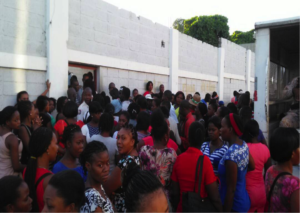
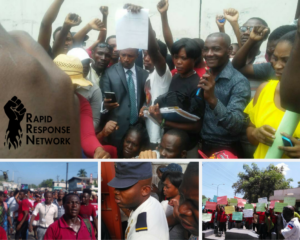
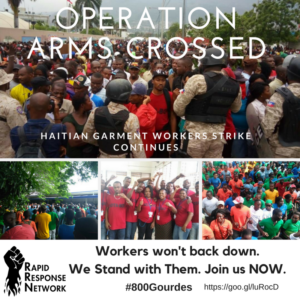
    In the days that followed this atrocity, workers continued their mobilization effort. On Thursday, February 24th, workers gathered in their usual location outside the Sonapi Industrial Park on Airport Road in Port Au Prince. As they waited for their sound truck to arrive, police opened fire on the assembled workers and their supporters, forcing them to disperse. Angered and undeterred, the workers gathered again outside the park the following day, Friday, February 25th. This time, they were attacked inside the industrial park with teargas when they attempted to gather more workers to join them. In response workers took the streets outside the park, burning tires and blocking the road.

    These days of mobilization were in response to the government’s insulting wage adjustment of 685 gourdes per day ($6.50 USD), far from the workers’ demand of 1,500 gourdes ($14.81 USD). In their announcement on February 21st, the government also said they would offer lunch and transportation subsidies for workers. (Transportation to and from work costs about 200 gourdes per day.) But, no details or timeline about how or when these programs would be implemented.

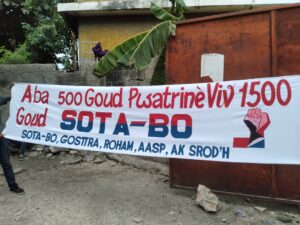
    "For 1,500 Gourdes without increased quotas!"
    “For 1,500 Gourdes without increased quotas!”

    The government also stayed quiet on the issue of production wages. In addition to the legal minimum wage set by the state, factory owners set a production wage based on a quota system. If workers reach their quota, they receive an additional wage above the minimum wage, sort of like a bonus… except even with this “bonus” their wages do not meet the costs of living. While this production wage is set by the private manufacturers, the government is supposed to also put forward a fair and legal suggestion of what this wage should be based on costs of living, inflation, etc. The government’s silence on this issue allows factory owners to continue their normal practice of setting quotas impossibly high, so that they never have to increase workers’ pay.

    Additionally, workers who participated in the strike and mobilization continue to be illegally fired and harassed at work. If the unions are not present to push back, union workers become eliminated and blacklisted from work in the industrial parks.

    Given this context, SOTA-BO in coalition with four other unions is shifting gears from the streets to dealing with firings, fighting factory owners on the production wage, and pressuring the government to follow through on their mention of subsidies. The unions told the prime minister, Ariel Henry, that he has until May to come up with a formal plan and to start implementing the promised meal and transportation subsidies.

    img_70541

    CALL TO ORGANIZE!

    While this situation is extreme in its brutality and clear-cut exploitation, the struggle of Haitian garment workers is universal… and most often, universally obscured. For example, in the constant and widespread coverage of the war in Ukraine, no attention has been paid to how this war affects Ukranian miners who have been in a battle to address their unlivable wages and incredibly dangerous working conditions.

    As our feeds are flooded with news of monumental wars, climate crises, racism and xenophobia, one fundamental reality remains the same – the need for food and goods that are produced and distributed by workers and laborers who are always being compelled to work more for less. And, just as the workers in Haiti and Ukraine are fighting back, so are laborers and workers across the US. People are refusing low wages, forming new unions, and striking at factories and plants across the country.

    At the same time, we are in a moment where the interests of profit have saturated every social and political issue, including labor. SEIU tried to block Puerto Rican teachers from doing what’s best for their interests. The AFL-CIO’s Solidarity Center has collaborated with the US government to wage war on dominated countries and to limit the demands of workers in countries outside the US. If we want to shift to organizing for what’s best for workers, children, communities and the planet, then we need organizations that remain independent from profit motives.

    This is why the RRN supports SOTA-BO and the other organizations affiliated with the Haitian workers movement Batay Ouvriye (BO). Different from many of the unions in the US and other imperialist countries, Batay Ouvriye has maintained its independence from political parties, nonprofits and union bureaucracies that try to cap the demands and struggles of workers. Without these constraints there is the possibility for laborers and workers to coordinate their efforts, to lend solidarity based on their common interests as the people who actually make society possible.

    The RRN encourages all efforts towards organization, better wages and working conditions. The network actively supports those who are organizing independently with rank and file workers leading decisions about their struggles and interests. And, we want to support more independent efforts! 

    • If you have been thinking about getting organized in your workplace and you want to talk about what it means and looks like to do that independently, then get in touch!
    • If you’re already organized and dealing with union bureaucracy and limitations, let’s talk about that too!
    • Are you angry, frustrated and want to talk more about what it means to organize? Get in touch.

    RRN is not an organization, but as a network we will work to put you in touch with folks already organizing independently.

    Let’s get organized! Let’s build international solidarity!

    RRNsolidarity@gmail.com
    Facebook
    Twitter

    Batay l’ap kontinye/The Struggle Continues

    Solidarity Forever!

  • SOTA-BO: Regroup & Onward!

    SOTA-BO: Regroup & Onward!

    The RRN extends MASSIVE thanks to all who have supported Haitian garment workers in their fight for 800 Gourdes minimum wage. Thanks in part to the pressure applied through international solidarity, workers were able to mobilize for three months, making significant gains in the level of their struggle. Workers turned out in record numbers, unified in their demands. Students, vendors, and neighborhood groups stood in solidarity with workers.

    07.11.17 - Port Au Prince - Workers' march.
    07.11.17 – Port Au Prince – Workers’ march.

    Normally, workers issues and their perspective are not found in Haiti’s mainstream newspapers, websites, nor do they concern government officials. However, this recent campaign elevated the scope and scale of garment workers struggles to the point that everyone in Haiti was talking about it. Everyone had to decide: “Which side are you on?” In Haiti and beyond, thousands sided with workers.

    As we previously reported, the Haitian Senate and President Jovenel Moise even felt compelled to feign support of the workers. Their posturing was shown as just that with their pathetic wage increase of 350 Gourdes.

    On Monday, July 31, 2017, workers planned to gather and march from the Sonapi Industrial Park in Port Au Prince to show their rejection of Moise’s bogus wage. They were met with heavy police presence, blocking the gates. Their guns were loaded with real bullets, rather than rubber ones.

    After three months of ongoing, tire-less mobilization and confrontation with bosses and increased police repression, workers have let us know it’s time to take a pause. This is not a stopping point. They will re-group, agitate and continue to organize, building on the strength gathered from this recent campaign.

    Thank you again for your emails, texts, social media posts and donations. They had a major impact. Thank you for choosing to act, to resist exploitation in the production of goods we consume. Thank you for standing on the side of workers.

    The struggle continues!

    Below is a bulletin put out by SOTA-BO textile union in Port Au Prince, on August 3rd, addressing fellow garment workers. Please read it. (Translated from Kreyol to English).


    How You Can Help

    If you’re asking how you can continue to help, the best way to do so now is with financial support. As you can imagine, after three months of ongoing work stoppage, strike, marches, leafletting, the unions and workers, funds are low.
    Your contribution will be to provide meals to workers at meetings; to print leaflets; to help transport organizers; and to recoup the costs of mobilizing in four locations, since May 19.

    CLICK HERE TO DONATE.

    Please be sure to also sign up for RRN email updates & to follow us on Facebook & Twitter.

    Thank you for your solidarity! <3


    SOTA-BO Bulletin, Circulated in Haiti

    Members of SOTA-BO textile union.


    TEXTILE AND APPAREL WORKERS UNION (SOTA-BO)

    Comrades,

    Since May First, we launched a mobilization to demand that the state set the minimum salary at 800 Gourdes (US $12.50). Now, after the draconian recommendation of the contested CSS, president Jovenel Moise adjusted the minimum salary at 350 Gourdes (US $5.47). On Monday July 31, we planned a march against the 350 Gourdes because we demanded 800 Gourdes at the least. However, our worker comrades did not come out to tell Jovenel they rejected the 350 Gourdes. This salary will not satisfy our needs. As it is, neither 335 Gourdes (US $5.23), 350 Gourdes, nor 800 Gourdes match up to what we need to take care of our families. In our viewpoint, this is not “create jobs.” This is disguised unemployment. Neither Jovenel nor the capitalists can live on such a salary. How is it that they want us, workers, who contribute so much in creating wealth agree to take in such low salary? What happened on Monday July 31? What did we see?

    1)   A large contingent of policemen occupying the park with the complicity of the factory owners to stop us from taking to the streets. In front of many factories, police cars stay put to intimidate workers who wanted to come out and had trucks of skin-irritant water cannon and other vehicles full of special police units such as BIM with heavy weapons ready to kill.

    2)   Some factory owners made offers to factory workers with a salary of 400 or 500 Gourdes a day and a 20% reduction in production quotas and other benefits such as food subsidies, Saturdays off and lottery to win a motorcycle to derail the workers so they keep working and not leave. Some other factory owners threatened workers with massive firings if the walk out for the protests.

    3)   There is also the stress on workers emerging from the fast approaching school opening in September; they feel they have to work to save some money for their kids to return to school.

    4)   There is also a level of movement fatigue in some workers. 3 months of struggle in the streets wasn’t easy for them. They didn’t get paid for the days they were out in the streets. The capitalists refuse to pay them because they say salary adjustment is not their job. The state has to do that. The struggle to adjust the minimum salary is a very important demand for the workers. It’s a union activity; if they inform MAST and the factory owners, participants in such activities should normally be paid their salaries.

    We denounce the use of police to intimidate workers. To participate in Union activities is a right for all workers to defend the economic and social interests. As for the factory owners who offered to pay 400/500 Gourdes today, they should continue to give it. 350 Gourdes today is the least they can give. Therefore, they began to give 400/500 Gourdes, they should continue to give it. This is a win for all workers who got it and they should continue to get it. LET THEIR HOAX BLOW UP IN THEIR FACES! LET’S ORGANIZE IN THE FACTORIES SO THE CAPITALISTS PAY US A LIVABLE WAGE. IN ADDITION, SALARY ADJUSTMENTS INDEXED TO INFLATION ACCORDING TO THE LAW. WHERE IS JOVENEL, WHERE IS THE POLICE TO MAKE THE CAPITALISTS OBEY THE LAW?

    We want to raise 2 points on the executive order published.  One, the workers lost almost a year as a result of the long delay on the part of the state in setting the minimum salary. According to the law, the minimum salary should have been adjusted since the month of October 2016. The new salary of 350 Gourdes begins on August First 2017; this represents a loss for all workers in the country. The government does not take that into account. Many workers thought that the salary of 350 Gourdes would be retroactive from May 2017 to help them make up for the 5 months in the fiscal year 2016-2017. The question now is what is being done for the fiscal year 2017-2018 with the rising inflation rate? Secondly, there is no mention of the production wage in the executive order. The 2009 Law on the minimum salary included it in articles 2, 2.1, 2.2. Therefore, the executive order violates current law. Is it why the executive order never mentioned anywhere the 2009 law? Can an executive order remove a gain already embedded in a law? SALARY ADJUSTMENT SHOULD BE IMPLEMENTED INDEXED TO RISING INFLATION ACCORDING TO THE LAW. THE GOVERNMENT VIA THE MINISTRY OF SOCIAL AFFAIRS AND LABOR SHOULD SEE TO IT THAT THE CAPITALISTS OBEY THE LAW.

    True, the Monday mobilization did not materialize. However, we must send kudos to the unionized and non-unionized workers for their participation in the past 3 months of STRUGGLE. We salute the determination and engagement of more than 25,000 workers who participated in the mobilizations. We managed to bring more workers on the streets in 2017 than in 2009 when we got a raise of 200 Gourdes back then. The current mobilizations took place thanks to the sacrifices of workers, mothers and fathers on all these days. That is why we cannot allow today’s loss to cloud out the GREAT FIGHT we just put up. We earned some points in the struggle. Among them, we fought for 800 Gourdes on an independent basis under the direction of our own combative unions that defended our interests as exploited workers under great pressure and threats. We had the support and solidarity of many people and organizations nationally and internationally. Many progressive and popular organizations were side by side with us on the streets. We were able to force a public debate on our miserly salary, bad working conditions, and the bankruptcy of the social security system such as ONA and OFATMA for many months.

    Even though our living conditions and our current level of social awareness today tend to derail us or slow us down in the struggle resulting in the fact that the weeklong mobilization we planned could not materialize, we proved that we can fight, we have what it takes to move forward in our struggle to change our living conditions. That is why we must work to consolidate our gains, solidify our unions that allowed us to launch the mobilizations for the minimum salary of 800 Gourdes. As many of you stated, it’s our union struggle that helped us win the 350 Gourdes because the capitalists did not want to adjust the salary at all. It’s true, 350 Gourdes is not enough; however, we got it as a result of our STRUGGLE.

    We have many other immediate demands to fight for such as negotiations on the wage of tariff production, reinstatement of fired workers and unionists because of their participation in the mobilizations, removal of the 2 fake representatives in the Supreme Salary Council (CSS), implementation of the social benefits with a commission to handle this question as it should, stop parliament from voting this rotten law of 3/8, relaunch tripartite negotiations on the labor code, etc. Come to the meetings so we can draw our battle plans for the days ahead and in the future. IT’S ONLY FIGHTING ON AN ORGANIZED FASHION IN OUR INDEPENDENT UNIONS WE WILL REACH THE DEPTH OF LIFE. LET’S CONSOLIDATE OUR UNIONS. THE STRUGGLE CONTINUES WITH MORE VIGOR!

    TEXTILE AND APPAREL WORKERS UNION (SOTA-BO)

    AUGUST 3, 2017

  • Police Block Industrial Park. President Offers a Bogus Wage.

    Police Block Industrial Park. President Offers a Bogus Wage.

    Monday – July 31, 2017 – Haitian garment workers planned to take the streets again today to demand 800 Gourdes/day (US$12.82) minimum wage. But, they encountered heavy police presence at the Sonapi Industrial Park in Port Au Prince. The police are blocking the gates to the industrial park, locking workers inside the gates of the park.

    Mon 07.31.17 - Port Au Prince - Police block the entrance of Sonapi Industrial Park.
    Mon 07.31.17 – Port Au Prince – Police block the entrance of Sonapi Industrial Park.

    SOTA-BO textile union planned to protest today and all this week in response to Haitian President, Jovenel Moise’s bogus wage proposal.

    Last week, the president sent a letter to the Supreme Council on Salaries (CSS) – the entity tasked with making a salary recommendation. In the letter, he said the council needed to come up with a wage that would allow workers to live. Previously, the council proposed a wage of 335 Gourdes, an insult to workers.

    The CSS, comprised of representatives of factory owners, the state and labor then lobbed this responsibility to the president. They called on him to make a recommendation to avoid upsetting factory owners, as the council is a farce. They consistently represent factory owners interests.

    Friday, July 28, 2017 – The RRN received word that President Jovenel Moise proposed a wage of 350 Gourdes – yet another insult to workers.

    jovenel-moise-780x405

    Workers have made their position clear – 800 Gourdes. This demand is actually a concession, if one looks at what is actually needed for a worker and their family to survive.  A 2014 study by The Solidarity Center titled “The High Cost of Low Wages in Haiti,” concluded that, based on a standard 48-hour work week, Haitian workers should be paid at least 1,006 gourdes per day to adequately provide for themselves and their families. That was three years ago. The cost of living has only increased since then.

    haitiworkersstrike

    We are waiting for next steps from workers.

    We will be in touch soon with ways to support and help continue the fight.

    Thank you so much for all your solidarity, thus far.

    The struggle continues!

    Please consider making a donation to help workers continue their efforts.

    Your contribution will be used to provide meals to workers at meetings; to print leaflets; to help transport organizers; and to recoup the costs of mobilizing in four locations, since May 19.

    After weeks of strikes and mobilizations, many have been arrested. Some must return to work in order to eat. Some have been denied entry into the factories for their participation in the strikes, and cannot pay rent. Some are facing medical bills from police repression.

    While many workers are hungry, tired, and struggling to survive, their resolve does not wane.

    They are determined to continue this fight. They must. Their survival depends on it.

    CLICK HERE TO DONATE.

    Thank you for your solidarity! <3